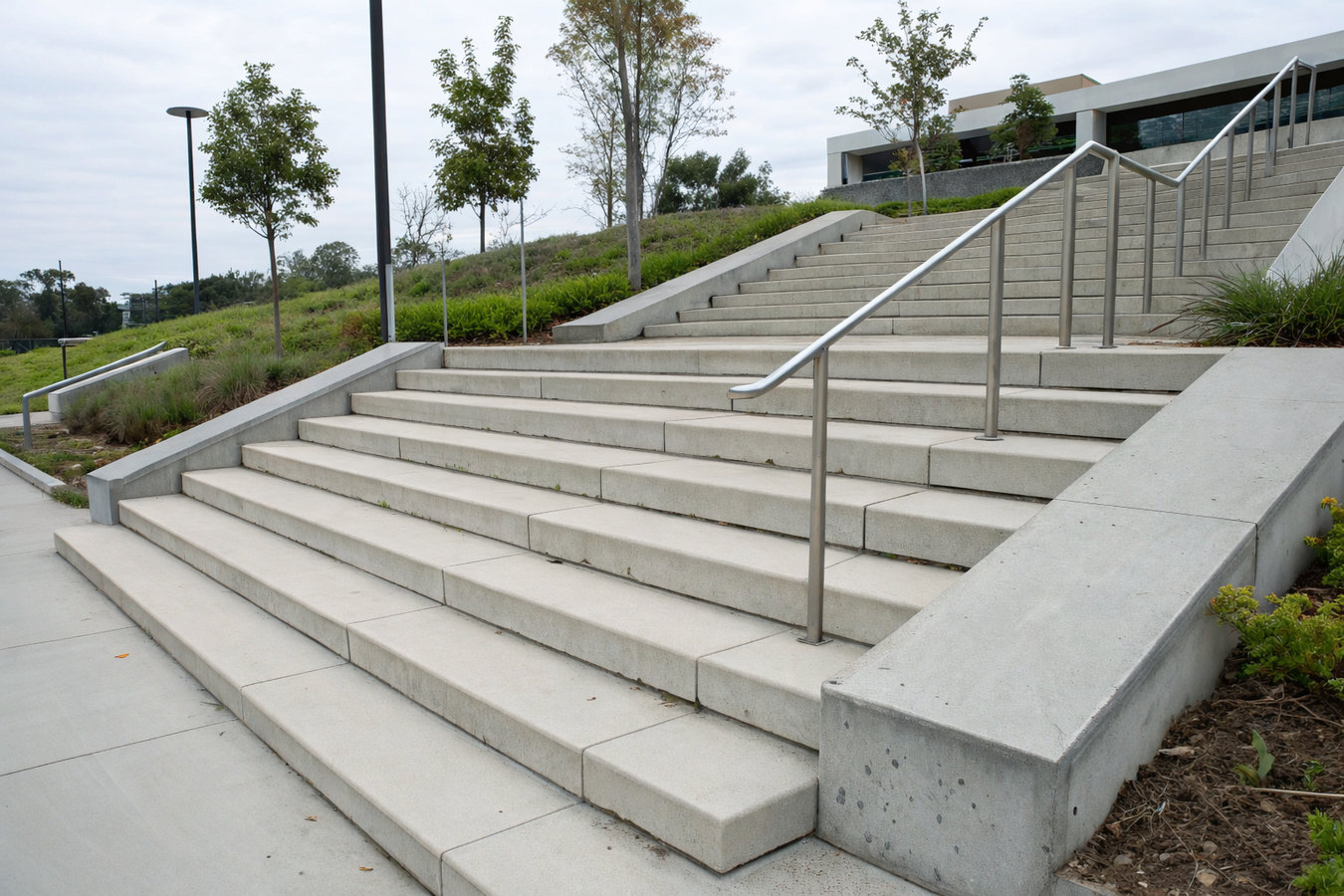
Cracked, tilting, or slippery front steps are a safety risk every season. We build concrete steps in Concord that hold up through New Hampshire winters and look right from the street.
Concrete steps construction in Concord involves demolishing any existing steps, excavating the area, compacting a gravel base, and pouring formed concrete finished with a textured surface for grip. Most residential step projects take one to two days of active work, then about a week of curing before the steps can handle normal foot traffic.
A large portion of Concord's housing stock was built before 1960, and many original concrete steps in neighborhoods like the South End, East Concord, and Penacook are at or past the end of their useful life. If your steps are cracking, tilting, or feel unsafe underfoot, replacement built to current standards - with a proper base and a permit - is almost always the better long-term investment over patching.
New steps pair naturally with a concrete sidewalk leading to your front door, or with slab foundation work if you are doing broader exterior improvements. We plan the elevations and drainage together so the finished result ties into your property properly.
Cracks running across step surfaces or thin chips peeling away are signs the structure is breaking down from the inside. In Concord, this damage almost always traces to years of freeze-thaw cycles and road salt, and once it starts it tends to accelerate quickly. Surface patching can buy a little time, but widespread damage usually makes replacement the more cost-effective choice.
Stand on each step and shift your weight. If any step moves or feels like it is not sitting flat, the foundation underneath has shifted. This is a safety issue - a tilted step is a trip hazard - and it is a sign that the base preparation was not adequate for Concord's soil conditions. A step that has moved once will continue to move.
If you can see daylight between the back of your steps and the foundation wall, the steps are pulling away from the house. This gap lets water in, which then freezes in winter and widens the separation. It also means the steps are no longer properly supported at the back - a structural concern beyond appearance.
If you or a family member has slipped on your front steps after rain or a light frost, the surface texture has worn smooth. Concord winters make this a genuine safety risk, not just an inconvenience. A smooth, worn concrete surface offers almost no grip when wet, and no amount of cleaning will restore the texture once it is gone.
We build front entry steps, side entrance stairs, and rear access stairs for residential properties throughout Concord and the surrounding area. Every project includes site excavation, compacted gravel base, permit application, concrete forming and pouring, and a broom finish for slip resistance. If you are also planning a walkway from the street to your door, our concrete sidewalk building service handles that work under the same crew so everything lines up in elevation and finish.
For homeowners doing larger exterior projects, steps connect naturally to slab foundation work on additions or outbuildings. We plan the two together where the scope calls for it so the final grades tie into each other correctly and drainage runs the right direction on both surfaces.
For homeowners replacing failing steps or building new entry stairs from scratch - includes demolition, sub-base preparation, forming, and finishing.
Suits garage entries, back doors, and deck access where steps need to match the surrounding hardscape and handle heavy foot traffic.
The practical choice for any exterior steps in Concord - provides grip in wet and icy conditions without extra maintenance.
We pull the City of Concord building permit on every steps project, so your work passes inspection and is properly documented.
Concord averages more than 170 frost days per year, and temperatures swing above and below freezing repeatedly through late fall and early spring. That freeze-thaw cycle is the single biggest threat to concrete steps - water enters tiny surface pores, freezes, expands, and chips the surface from the inside out. Steps built without a cold-climate concrete mix and a properly textured finish will show damage within a season or two. Road salt, which Concord homeowners rely on heavily through winter, accelerates that process - especially in the first year after a pour when the surface is still hardening.
Much of Concord also sits on glacial till and clay-heavy subsoil that shifts with seasonal frost and moisture changes. Steps in older neighborhoods like East Concord and the South End were often built without the compacted gravel base that current practice requires, which is why so many are tilting or pulling away from foundations. Homeowners in Manchester and Dover deal with the same soil and climate conditions. For current building permit requirements, the City of Concord building division handles structural exterior work applications.
We will ask how many steps you need, whether existing steps must be removed, and roughly how wide the staircase is. Most contractors schedule a brief site visit before giving a firm price - things like soil conditions and access affect the cost. We reply within one business day.
For new concrete steps in Concord, we apply for the required city building permit before any work begins. This typically takes a few days to a week. We handle all the paperwork - you do not need to do anything except confirm your address and project details.
We remove your old steps if needed, excavate the area, compact the soil, and lay a gravel base. This prep work is what determines whether your steps stay level for decades or start shifting after a few winters - it is the step we never skip.
We build the wooden form, pour the concrete, and add a broom finish for grip. Curing takes about three to five days before light foot traffic. A city inspector signs off on the permit, and we walk you through the sealing schedule before we leave.
Free written estimate. No obligation. We reply within one business day.
(603) 802-8228Every set of steps we build gets a textured broom finish that provides grip in wet and icy conditions. A smooth surface is a winter hazard - we do not pour one. We also use a concrete mix suited to New Hampshire's freeze-thaw climate.
We pull the City of Concord building permit on every steps project, which means an inspector reviews the finished work. That inspection record protects you at resale and confirms the job was done to code - not just to our own standard.
Much of Concord sits on glacial till and clay-heavy subsoil that shifts with seasonal frost. We evaluate soil conditions and set a compacted gravel base before every pour. This is the preparation step that separates steps that stay level from steps that tilt after a few winters.
We visit the site in person and give you a written quote that covers demolition, materials, permit fees, and cleanup before a shovel goes in the ground. If something unexpected comes up during prep, you hear about it before it affects your bill.
Taken together, these details reflect a simple principle: concrete steps that serve Concord homeowners well are built differently than steps poured somewhere with a milder climate. We apply that local knowledge to every project, from the sub-base to the surface finish.
For cold-weather concreting standards and mix design guidance, the National Ready Mixed Concrete Association publishes concrete-in-practice guidelines used by contractors across the industry.
Coordinate steps with broader foundation or addition work so grades and drainage align across the full project.
Learn MoreConnect your new front steps to a poured concrete walkway that handles Concord winters and stays level for years.
Learn MoreSpring is the busiest season for concrete work in Concord - reach out now and lock in your start date before the schedule closes.